
August 2026: Sitecore XP 10.5 landed, and only the community wrote it down
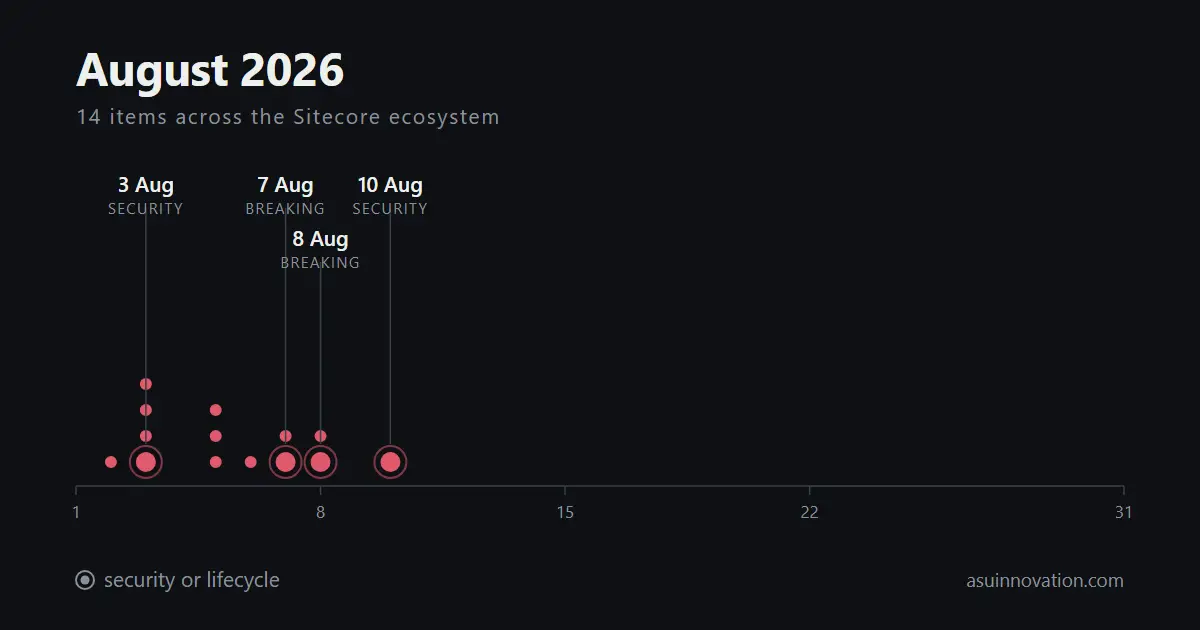
If you run Sitecore XP on containers or on metal, the opening days of August 2026 handed you something that is not a CMS upgrade. Two Sitecore MVPs, writing three days apart, describe XP 10.5 as a release whose weight sits underneath the application: Solr 10 as the only supported search backend with no compatibility path back to 8 or 9, SQL Server 2019 out of the support matrix, Windows Server 2019 container images no longer shipped, and the Package Installer disabled by default.
Now notice what that paragraph does not have: a link to Sitecore. Every account of 10.5 in this window is a community account. Vishal Khera and Ramiro Batallas both say they are working from Sitecore's own release notes and breaking-change register, both write like people who have done the upgrade work, and neither of them is the vendor. Version gates, removed support and changed defaults are exactly the class of claim that needs a vendor-official source before anyone books a date. Read both posts, then confirm the gates against Sitecore's documentation before you put 10.5 on a roadmap.
One more thing before the items: this covers the first ten days of August, not the month. The corpus stops on 10 August, so anything Sitecore shipped between the 11th and the 31st is not here and is not absent — it is simply outside the window.
What the two 10.5 accounts actually say
Sitecore XP 10.5: what's new and the upgrade gates nobody should skip — Vishal Khera, Insights with Vishal Khera
The gate table is the reason to read this. Khera dates the release to 5 August and sequences
the work: Solr first, then SQL, then Windows hosts, then Sitecore. He also flags the changes
that arrive silently, which are the ones that cost you a sprint — sort and facet semantics
shifting with SortableTextField, Solr queries defaulting to POST, managed-schema renamed to
managed-schema.xml, and duplicate-name checking on publish turned on by default. The harvest
recorded his byline as a mangled string of MVP badges; the author is Vishal Khera.
Sitecore XP 10.5 under the hood: containers, Solr 10, .NET 4.8.1, security and upgrade considerations — Ramiro Batallas, Ramiro's Sitecore Blog Six thousand words of engineering plan, and the argument in one line: treat 10.5 as "an infrastructure modernization program that contains an application upgrade, not as an application upgrade that happens to touch infrastructure". His most useful practical point is that the LTSC2019 hunt is not confined to your Compose file — custom tools images, init containers, build agents and pipeline definitions all carry the old baseline, and a build host can fail on an image the runtime would have accepted. He also notes that several modules were still listed as compatibility-pending at release. Worth checking yours before you estimate. The site served this post with its SEO title template unrendered, so our harvest captured the title as a literal placeholder; the heading above is the one in the article body.
Packages are quietly being retired as a way to move content
Three separate items in ten days point the same direction, and together they are the actual story of the window.
Sitecore monthly recap — July 2026 — Kiran Patil, Sitecore basics!
Thirty-two changelog entries across SitecoreAI, Content Hub and OrderCloud, rewritten as five
readable stories. Patil leads on the 1.8.24 base image retiring the legacy Package Designer in
favour of deployment and content-transfer tooling. Each item links the corresponding
developers.sitecore.com changelog entry, which is the right way to build this kind of digest
and also means you can verify the ones that affect you.
Sitecore AI content migration: consume the chunks in the destination environment and retrieve the transfer details — posted under the handle sandeeppote, on Sandeep Pote's blog Two short posts, mostly HTTP verbs, URLs and response payloads for the Items Transfer API. They are the working end of the change Patil describes: if packages are going away, this is what replaces them, and here are the actual endpoints. Bookmark rather than read.
SitecoreAI Pathway: what it actually migrates — Vishal Khera The scoping post to send anyone who heard "AI-assisted migration" and mentally booked three weeks. Khera's summary is that "Pathway is an intelligent mapper, not an architect": you build the target layout, templates, components and page designs first, and page designs, partial designs, xDB data, email content and personalization stay on your side of the line. He puts the web crawler's ceiling at 200 URLs, which changes sequencing on any site of consequence. Again, community-sourced product boundaries — check them against the marketplace listing before they land in a statement of work.
The rest of the field
Sitecore configuration files: separating server role from environment type — Hishaam Namooya, Hishaam — My Sitecore Journey
The best thing here for day-to-day XP work. Role and environment are two independent axes, and
the rule-based config reader will honour a custom env:define alongside role:define if you
declare it. Teams that assume ContentDelivery implies production have been paying for that
assumption in config bugs for years.
Sitecore Search component generator — Krushna, Code By Krushna (the page credits a first name only) A generator for the boilerplate every Sitecore Search project rewrites: results page, autocomplete, facets, pagination, URL sync, in TypeScript or JavaScript, Tailwind or plain CSS. Krushna wrote and publishes the tool, so the recommendation and the author are the same party. The code is on GitHub, which is the only review that matters.
Sitecore Content Hub for dummies 2026: the state of the platform — Timothy Marsh Positioning rather than engineering, and useful for that. Marsh reads the Scrunch acquisition as Sitecore buying the layer that sees how AI systems surface your content, and argues provenance work such as C2PA support has moved from compliance checkbox to sellable feature: "a meaningfully different pitch than 'we store your assets'". Analyst placements do a lot of work in his argument, so weigh it accordingly.
Growth Ops: building an AI-native marketing operating model — David San Filippo, mtelligent.com Marketing operations redesigned around agents as participants rather than tools. It is a position paper, not an implementation guide, and the honest test is whether your content operations process would survive being written down at all. The harvest recorded his byline with the publication date attached to it; the author is David San Filippo.
Underneath the platform
Next.js 16.3.0 — cut by timneutkens, on Vercel's releases feed
The one hard-sourced item in the window, because it comes from the repository itself. The
release updates vendored lodash to 4.17.23 for CVE-2025-13465, restores Content-Length and
ETag on /_next/data/ JSON responses, and renames /_next/webpack-hmr to /_next/hmr. If
your head application is Next.js, the CVE line is the reason to read the notes.
Azure DevOps remote MCP server is generally available — Dan Hellem, Azure DevOps Blog (Microsoft's own blog, about Microsoft's own product)
A hosted endpoint replaces the local MCP server, so an assistant reaches Boards and Repos over
streamable HTTP with a few lines of mcp.json. For Sitecore teams on Azure DevOps this removes
the "everyone installs it locally" step. It also means ticket text becomes model input, which
is worth a policy conversation before it becomes a habit.
What we're watching
Here is the thing that should bother you more than the Solr migration. Every Sitecore source cited above is a personal blog, and not one of them declares an employer. Our source registry records their commercial interest as unresolved, which means none of them can be read as independent by default — not because anyone is hiding anything, but because nobody said. The entire public account of a mandatory infrastructure upgrade, in these ten days, sits on unpaid sites written by people whose day jobs we cannot name.
That is not a complaint about the writers, who did the work. It is a complaint about the shape of the record. When the vendor's release notes are behind a documentation portal and the practical reading of them lives on WordPress, the version of 10.5 most teams will actually plan against is the community version. Which makes the boring advice load-bearing: cite the vendor page in your upgrade ticket, not the blog post that explained it to you.
And plan 10.5 as infrastructure. Batallas is right about the sequencing, and a team that books it as a CMS upgrade will discover the Solr work in week three, in front of an audience.
Sources
- Sitecore Monthly Recap — July 2026 — Kiran Patil, Sitecore basics!
- Sitecore XP 10.5: What's New and the Upgrade Gates Nobody Should Skip — Vishal Khera, Insights with Vishal Khera
- Sitecore XP 10.5 Under the Hood: Containers, Solr 10, .NET 4.8.1, Security, and Upgrade Considerations — Ramiro Batallas, Ramiro's Sitecore Blog
- vercel/next.js v16.3.0 — timneutkens, Next.js releases
- Sitecore Content Hub for Dummies 2026: The State of the Platform — Timothy Marsh
- SITECORE AI PATHWAY: What It Actually Migrates — and the Five Things You Still Do Yourself — Vishal Khera, Insights with Vishal Khera
- Azure DevOps Remote MCP Server is generally available — Dan Hellem, Azure DevOps Blog
- Growth Ops: Building an AI-Native Marketing Operating Model — David San Filippo, mtelligent.com
- Sitecore AI Content Migration — retrieve the transfer details — sandeeppote, Sandeep Pote's blog
- Sitecore Configuration Files – Separating Server Role from Environment Type — Hishaam Namooya, Hishaam — My Sitecore Journey
- Sitecore AI Content Migration — consume the chunks in destination environment — sandeeppote, Sandeep Pote's blog
- Sitecore Search Component Generator — Krushna, Code By Krushna