
February 2026: everyone explained SitecoreAI except Sitecore
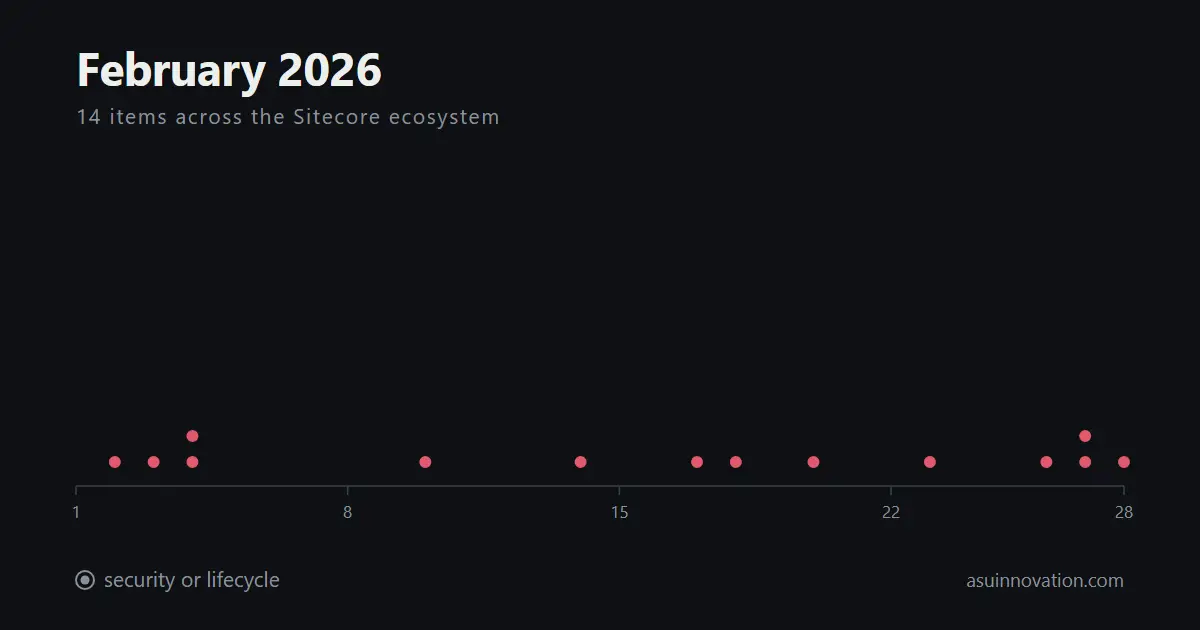
Sixty Sitecore articles cleared our February window. Not one of them came from sitecore.com.
Everything the month said about SitecoreAI — which products are now folded into it, what an existing XM Cloud customer pays for them, how long Pathways takes to move ten thousand pages — was written by practitioners on personal blogs. The author with the most specific migration numbers says in the post that he has not run the tool.
That is February's story, and it is not a release story. A platform got renamed and rebundled, and the work of explaining both fell to people doing it in their evenings, without access to a price list.
What SitecoreAI includes, according to people who do not set the price
Understanding Sitecore AI: capabilities included out of the box — Chandan, writing on his personal blog at chandan-sitecore.blogspot.com. Our harvest recorded the outlet as "Sitecore", which is the blog's own title and not the vendor. The most useful mapping published this month: a table placing each legacy product against its slot in the new packaging. CDP and Stream inside a Unified Data Layer in the core, Search and Personalize together under Conversion Optimization, Content Hub as the DAM module. It also carries the two claims most likely to end up in somebody's proposal, that existing XM Cloud customers get the AI layer at no additional cost and that pricing is now outcome-based. Chandan is a practitioner, not Sitecore. We found no vendor-official source for either claim, and both are exactly the sort you want in writing from an account manager before you quote a client.
Sitecore AI Pathways: a deep dive into the CMS migration tools, part 2 — the page carries no byline. Published on Sitecore Tweaks; our harvest recorded the author as "Posted on", which is an extraction artefact rather than a person. Four questions answered: who gets access, how long 5,000 to 10,000 pages takes, whether you have to expose your CM, and whether it handles non-Sitecore sources. The durations are hours for a simple implementation, about a day for moderate, several for a heavily customised one, against a claimed reduction of up to 70% versus manual migration. Then comes the sentence that should govern how you read all of it: "I have not tested this functionality firsthand." Fair of the author to say, and it means anyone sizing a migration on these figures is sizing it on compiled hearsay that has been honestly labelled as such.
5 powerful advantages of Sitecore AI + Content SDK — Nidhi Paneri, Nidhi Paneri | Blogs Thin. Five headings of benefit language with no implementation underneath. It is here because it is representative: a large share of February's SitecoreAI writing has this shape, and a reader skimming titles cannot tell it apart from the two posts above until they open it.
Two posts you can actually work from
Managing rich text editor profiles in SitecoreAI — Marcel Gruber. The harvest recorded no byline; the blog is his and the post is written in the first person.
The best operational writing of the month, and the only piece here that will cost you a day if you
miss it. The RTE is CKEditor 5 now and the old approach is dead in a particularly unhelpful way:
editing profile items in the core database still works as an action and achieves nothing, because
rich text fields no longer resolve the profile ID in the Source field. "There is no UI for managing
this in SitecoreAI. You have to use the REST API," Gruber writes. The path is OAuth client
credentials from the Deploy Portal, a POST to the editor-profiles endpoint, then a PATCH on the site
to assign the returned ID. He links Sitecore's own changelog entry dating the capability to 13
January 2026. The detail worth the click on its own: in PowerShell, curl is an alias for
Invoke-WebRequest and will quietly mangle your request. Use curl.exe or Invoke-RestMethod, and
keep the payload in a file.
Translating items with Sitecore Stream AI — Maulik Darji, CMS Sky
Short and screenshot-led. Switch to a language with no version and a second option appears beside the
usual "Add a new version": create it through Stream Translate, choose which fields go to the queue,
run it. Darji puts the requirement at version 1.5.89 or later plus a Sitecore AiClient role, and
says Brand Kits for tone of voice are a premium feature. Those specifics come from a community post
rather than from Sitecore, though he links the vendor documentation for both; read his links before
you plan a rollout around them. The use he suggests is the one I would reach for first anyway,
generating genuine localised strings to test right-to-left layouts and long-string expansion, which
beats lorem ipsum that never breaks anything.
One agent worth pointing at a real site
AEO/SEO Researcher: is your website ready for the age of answer engines? — Gabriel Baldeon, Sitecore Center Baldeon runs the agent against goldengate.org instead of a demo tenant, which is what makes the post worth reading. Cloud Portal, Agentic, see all agents, feed it a URL, and it scores structured data, semantic clarity, E-E-A-T signals and citation readiness. The framing is the part to take into a client conversation: the question has moved from "do we rank" to "are we the source AI engines choose to reference?" What nobody can tell you yet is whether the scoring is calibrated against anything. The output reads as a prioritised list, not a measurement.
Away from the AI story, the ordinary problems continued
A couple of patterns for fetching content with GraphQL in a headless app — Navan, Navan Sitecore Notes
The default page size is ten, and developers arriving from the MVC and LINQ era keep walking into it
with a select * reflex. Navan sets bulk fetching against paging and is honest about the cost of the
first one: the maximum count lives in front-end code, so changing it means a redeploy. He also points
at the "query is too complex" error and the standard cure of asking for less. If your team's first
headless component was a search list, this is your post.
Composable DXP architecture with Sitecore SaaS — the page credits nobody by name; the blog is Koushik Mukherjee's Placement rather than product tour. What belongs in the delivery tier (very little), what belongs in the decisioning engines, and why point-to-point wiring between SaaS products is the thing that rots first. Useful the next time someone asks why you are not personalising inside the rendering host.
The community calendar, and who is selling what
February is MVP month and two announcements landed in our window: Jeroen Breuer's fourth Technology MVP (the post carries no byline and is written in the first person on his own domain) and a press release announcing Anton Tishchenko's eighth, published on the EXDST blog, also with no byline on the page.
Three of our fourteen sources are that same EXDST blog, which is worth saying plainly. Two of them concern the company's own open-source Figma MCP server: a demo comparing it against Figma's newly announced Claude Code integration, and a debrief on winning Product of the Day. The harvest recorded no author for the demo, but the page itself is bylined Anton Tishchenko, so the record was wrong; the Product Hunt post carries no byline. Read the first as a vendor's account of being overtaken by the platform it builds on, where "we might not agree with the approach that Figma takes" is carrying considerable weight. The second is the more useful, largely for what it says about paid upvotes.
Sitecore Hackathon 2026 prep: 8 tips from a hackathon vet — Gabe Streza, who works at Genpact Experience, a firm that delivers Sitecore commercially "The Hackathon is often won before the clock starts," and the tips are all about what you can legitimately have ready before it does. Worth reading well after the event, because most of it is really about how to start any 24-hour piece of work.
Today's special: PluginSmith — Roel van Roozendaal, Restaurant of Mistaken Orders, who built the thing he is recommending A free macOS app that turns documents into Claude Code plugins, parsing locally. Not Sitecore-specific in the slightest. It is here because a growing number of Sitecore teams now maintain agent tooling as part of the day job, and the boilerplate he got tired of is the boilerplate they are writing.
What this costs the next person who quotes a migration
A vendor can rename its platform and rebundle its products without publishing a word, because the community will do the explaining for nothing. February shows the mechanism works. It also shows the price: the figures now circulating about SitecoreAI entitlements and Pathways throughput are compiled, hedged, and in one case explicitly untested, and they are the figures that will be pasted into statements of work over the next quarter.
So a working rule until Sitecore publishes its own version. Anything from this month's crop touching packaging, entitlement or migration duration is a hypothesis, and it needs a named Sitecore contact behind it before it reaches a client document. Anything touching an API — Gruber's editor profiles, Darji's translation flow, Navan's query patterns — can be verified against a tenant this afternoon, and that is the material worth keeping.
None of this is a complaint about the community writing. It is the only reason anybody knows how SitecoreAI works.
Sources
- Understanding Sitecore AI: Capabilities Included Out of the Box — Chandan, chandan-sitecore.blogspot.com
- Sitecore AI Pathways: A Deep Dive Into Sitecore CMS Migration Tools – 2 — no byline on the page, Sitecore Tweaks
- 5 Powerful Advantages of Sitecore AI + Content SDK — Nidhi Paneri, Nidhi Paneri | Blogs
- Managing Rich Text Editor Profiles in SitecoreAI — Marcel Gruber, MG on SC
- Translate the items using Sitecore Stream AI — Maulik Darji, CMS Sky
- AEO/SEO Researcher – Is Your Website Ready for the Age of Answer Engines? — Gabriel Baldeon, Sitecore Center
- A couple of patterns to fetch content using GraphQL in headless application — Navan, Navan Sitecore Notes
- Composable DXP Architecture with Sitecore SaaS: An Architect's Perspective — no byline on the page, Koushik Mukherjee – Sitecore MVP
- Sitecore Technology MVP 2026! — no byline on the page, jeroenbreuer.nl
- Anton Tishchenko Recognized as Sitecore MVP 2026 — no byline on the page, EXDST
- From Claude Code to Figma — Anton Tishchenko, EXDST
- Product Hunt: How to win Product of the Day? — no byline on the page, EXDST
- Sitecore Hackathon 2026 Prep: 8 Tips From a Hackathon Vet — Gabe Streza, Genpact Experience
- Today's Special: PluginSmith! The Dish Nobody Ordered But Everyone Needed — Roel van Roozendaal, Restaurant of Mistaken Orders