
July 2025: Sitecore shipped 10.4 Update 1 and the community wrote the upgrade notes
If you moved to Sitecore 10.4 Update 1 in July 2025, you probably lost an afternoon to one of two things: Identity Server refusing to hand you back to the CMS after login, or Solr rejecting every index update. Both were written up that month. Neither was written up by Sitecore.
That is the shape of the month, and it is worth stating at the top: not one of the fourteen pieces below comes from sitecore.com. The field notes for the release everyone was being told to install were produced by practitioners, on Blogspot and WordPress.com, on their own time.
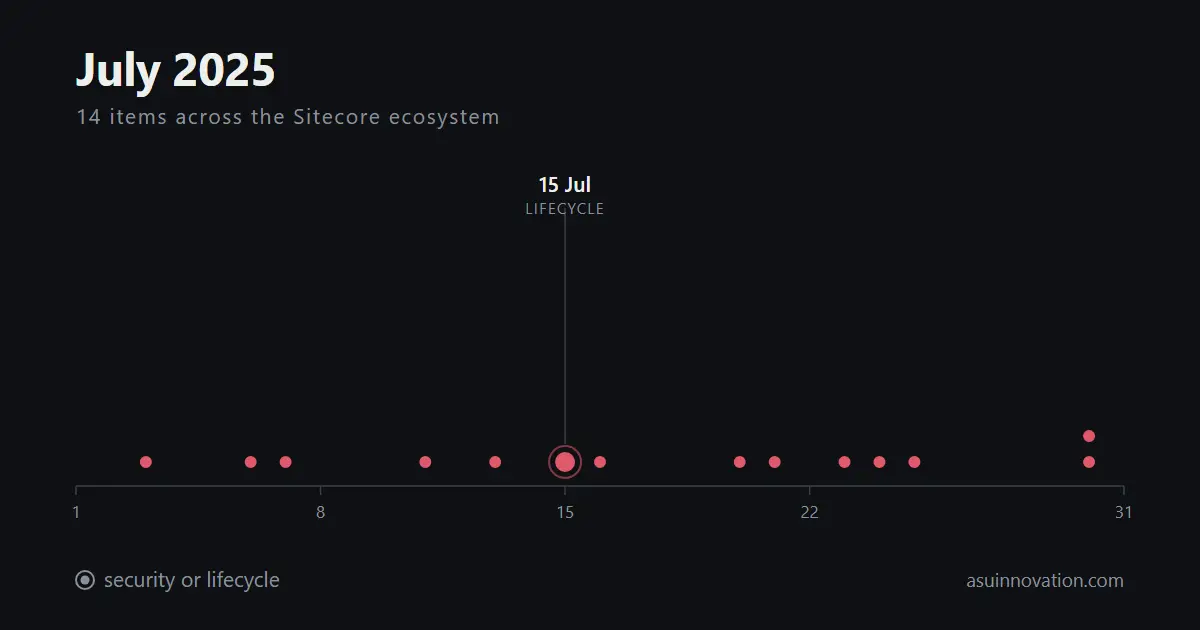
One caveat on coverage. We reached July 2025 through feed archives rather than live harvesting, which puts 53 Sitecore items in scope where a current month gives us more, and some of what was published then is no longer reachable at all.
The two walls of 10.4 Update 1
Himmat Singh Dulawat installed 10.4.1 on a developer workstation, logged into Identity Server,
and got Sorry, there was an error. with nothing in the Sitecore logs to explain it. The cause
turned out to be in section 2.8 of the Quick Install Guide: a newer Microsoft.Data.SqlClient
enforces encrypted SQL connections, and Identity Server 8 and later inherit that. His fix is a
connection-string edit in Sitecore.IdentityServer.Host.xml, plus an IIS restart. Dulawat's
site names no employer, so treat this as one practitioner's install rather than a vetted
vendor procedure.
Peter Prochazka hit the second wall on an upgrade already in flight. 10.4.1 brings Solr 9.8.1,
whose default NumFieldLimitingUpdateRequestProcessorFactory caps a core at 1000 fields.
Sitecore raises that to 2000 in sitecore-solr.json, and for Prochazka's solution it still was
not enough: his log filled with Current core has 2837 fields, exceeding the max-fields limit of 2000. Two ways out, and the cleaner one, raising Solr.MaxFieldsValue, requires uninstalling
and reinstalling the instance. The other is editing solrconfig.xml in the core directly and
restarting Solr. Prochazka's site also names no employer.
The "what changed" summary came from TECHHUB, published under the handle nikitavashisht29: Solr 8.11.2 to 9.8.1, encrypted SQL by default, Identity Server on .NET 8, and the observation that the release "may look like a small patch at first glance". Every version number in this section reaches us through a community blog rather than a vendor page. Each of those posts links Sitecore's own release notes; read those before you schedule the window.
Two independent bloggers, five days apart, on two different blockers in the same release. That is not a coincidence, it is a sample.
Solr got harder, so the operations writing got better
Chirag Goel, writing at Coders Lifeline, published the clearest treatment of SwitchOnRebuild
I have read: the two-core pattern where Sitecore rebuilds into <indexname>_rebuild and swaps
the active reference on completion, with the config XML included rather than described. If your
10.4.1 move includes a full reindex on a production instance, this is the piece that decides
whether that reindex is visible to users.
The other operational item is Find and Fix Sitecore Media Items Missing Their Media Blobs, on
thebitsthatbyte.com. Our harvest recorded the author as "Name *", which is the label on the
site's comment form rather than a byline; the page credits nobody. The post is still worth the
click. It documents a failure mode that hides well: publishing works from the Content Editor
and fails from the serialization CLI, with BlobProviderException in the log, because media
items exist without their blobs. The Sitecore PowerShell script that lists the affected items
ships with the delete line commented out, which is the right default.
The AI layer arrived with community documentation only
Anton Tishchenko released Sitecore MCP Server 1.0.0 on 24 July, with 102 tools: 2 for GraphQL, 11 for the Item Service API, 89 wrapping PowerShell commands. Our source record listed this page as having no byline, and the record was wrong; the page credits Tishchenko in the body, and he is the maintainer. He also runs EXDST, which sells AI integration work off the back of the project, and the post closes with a contact link, so read it as a maintainer's release note rather than an assessment.
What makes it a good one is that he argues against his own number. He writes that "100+ tools are too many", that they covered every API for testing rather than because all of them earn their place, that GraphQL tools only work with large-context models, and that some tools will be disabled by default or deleted. Vendor release notes almost never do that.
Sitecore Stream produced two community write-ups at the end of the month and no vendor explainer we could reach. Daivagna Nanavati documented the Stream REST APIs for partners: brand-kit management, document upload, and the ingestion pipeline that chunks and vectorises brand documents. His most useful line is a scope warning that will cost someone a day if they miss it: brand-kit keys are a different credential from XP/XM keys and do not grant access to each other's APIs. Nanavati's own site names no employer.
The second Stream piece, also from TECHHUB under nikitavashisht29, walks the project / deliverable / task model. Two of our fourteen items come from that one blog, which is 14% of the citation set and below the level where we would flag it as concentration, but it is worth knowing when you weigh how much of this month is one person's reading.
The XM Cloud front end
Nidhi Paneri traced the Content SDK's beta line: 0.1.0 in April, 0.2.0 in May with React 19 and Next.js 15 support, 0.3.0 in July. She writes that general availability was "expected around September 2025". That is a roadmap claim from a community source and it should be confirmed against Sitecore before anyone plans a delivery date on it. Paneri's site names no employer.
Jaina Baumgartner explained how to build a custom Personalize condition and surface it inside XM Cloud. She runs Pixleration, her own Sitecore consultancy, so this is writing about work she sells. Her argument holds anyway, and it is the sharpest criticism of composable Sitecore in this month's set: XP let you personalise with the components, content and logic already in the CMS, the split into XM Cloud plus Personalize forced you to duplicate one or build a decision model, and this integration walks that back.
Marcel Gruber wrote up automated front-end tests with Playwright driven from GitHub Actions against Sitecore XM on Azure PaaS with a Next.js head. Our record listed no author for this page; the blog is signed at site level, "A Sitecore blog by Marcel Gruber", on his own domain, so the record was wrong. He opens with the real reason enterprise Sitecore projects have no tests, which is not laziness but the inability to build the business case for the setup cost.
The strategy pieces, which are the thin part
Three items this month argue about direction rather than mechanics. Theresa Gutierrez published a professional-services modernisation blueprint at Fishtank Consulting, who implement Sitecore commercially; it is organised and readable and it is a pitch. Boris Brodsky argued that AI is reshaping team structure toward smaller squads and packaged business capabilities, on a site that names no employer. Ketan Sethi wrote about proving personalisation ROI with CDP and Personalize, framed around attribution chaos.
None of the three gives you something to do on Monday. In a month this dominated by upgrade mechanics, that gap is the story rather than a complaint about the authors.
What July 2025 actually cost
A release numbered as an update, which changes the SQL connection contract and moves the search engine a major version, is not an update. Sitecore shipped the fixes and left the migration notes to volunteers, and that is a support decision rather than an engineering one. The two posts that would have saved a team the most time in July 2025 sit on Blogspot and on a personal WordPress, and we reached them through feed archives, which is a polite way of saying they were already hard to find thirteen months later.
If you are still on 10.4 and planning the move, the useful reading order is Prochazka on the Solr cap, Dulawat on Identity Server, then Goel on rebuilding without downtime. Budget for the reinstall.
Sources
- Sorry, there was an error - Sitecore 10.4 Update installation — Himmat Singh Dulawat
- Sitecore 10.4.1 – Solr issue with "Current core has 2837 fields, exceeding the max-fields limit of 2000" — Peter Prochazka
- Sitecore 10.4.1 Update: Key Highlights — published under the handle nikitavashisht29, TECHHUB
- Zero Downtime Solr Index Rebuilding in Sitecore Environments — Chirag Goel, Coders Lifeline
- Find and Fix Sitecore Media Items Missing Their Media Blobs — thebitsthatbyte.com, no byline credited on the page
- Sitecore MCP Server: Release 1.0.0 — Anton Tishchenko, EXDST
- Sitecore Stream - Manage brand kits and brand documents and ingest using REST API — Daivagna Nanavati
- Orchestrate a Project in Sitecore Stream — published under the handle nikitavashisht29, TECHHUB
- Sitecore Content SDK — Nidhi Paneri
- How to Create a Custom Rule for Sitecore XM Cloud in Sitecore Personalize — Jaina Baumgartner, Pixleration
- Automated Front Tests with GitHub Actions & Playwright — Marcel Gruber
- Modernizing the Professional Services Industry with Sitecore — Theresa Gutierrez, Fishtank Consulting
- Rethinking Digital Transformation Starts with Ditching Legacy Stack — Boris Brodsky
- A Guide with Sitecore CDP — Ketan Sethi