
June 2025: Sitecore shipped 10.4.1 quietly, and personal blogs wrote the release notes
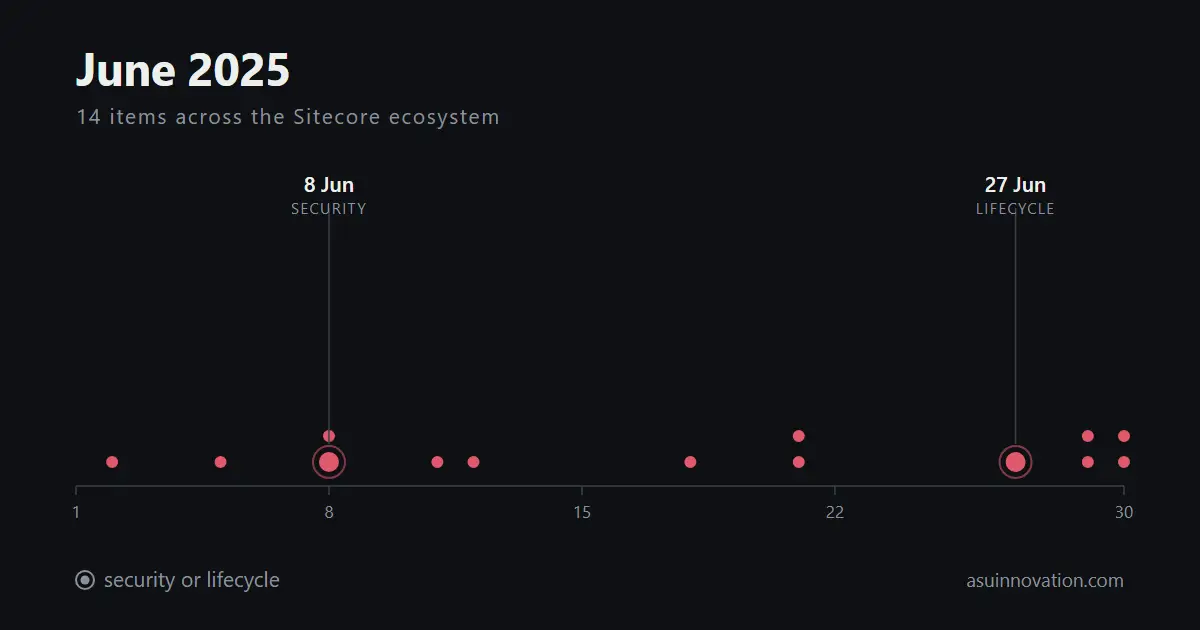
Sitecore shipped 10.4.1 on 25 June 2025. If that is news to you, that is the story of the month: the update carries breaking changes and a fix for a vulnerability Sitecore documented in its own KB, and the write-ups that told practitioners about it were personal blogs.
The second thing that happened in June 2025 sits awkwardly beside the first. This is the month the community started pointing AI agents at running Sitecore instances. Four of the eleven items below are about the Model Context Protocol, and none of them had an authentication story that would survive a security review.
10.4.1: two personal blogs did the release-notes job
Sitecore 10.4.1 Released — Peter Prochazka, tothecore.sk Prochazka expected "just another 'security' release to update referenced nuget packages" and got more. On his account: Solr moves from an end-of-life 8.11.2 to 9.8.1, Identity Server from 7.1.11 to 8.0.16 on .NET 8, and Publishing Service 8.0.3 shipped the same day. Then the breaking changes. SQL Server communication is encrypted by default and a schema change means running the upgrade script, Application Insights expects a connection string rather than an instrumentation key, and the new Solr container image requires the matching 10.4.1 container deployment package. He also reports a fix for a critical vulnerability, pointing at Sitecore's KB1003667. That is version numbers, breaking changes and a security fix all coming from a community source, so read Sitecore's release notes and installation guide before you schedule anything.
Sitecore 10.4.1 - Simpler, Faster, and More Secure — Nidhi Paneri
The same release read independently, which is worth more than a second link. Paneri adds the
practical shape of the SQL change: Encrypt=true;TrustServerCertificate=false plus a trusted
certificate on the server, or Identity Server stops talking to its database. She also flags two
things nobody advertised, an installer that waits for Solr to be ready, and an option to install
hotfixes automatically. Where the two posts agree you can plan. Where they are silent, the vendor
documentation is still the only record.
The month agents got credentials to live instances
Sitecore MCP Server: Secure Work with Remote Servers — Anton Tishchenko, exdst.com Our harvest record carries no byline for this post. The page itself credits Anton Tishchenko, so the record is wrong, and he maintains the Sitecore MCP server he is describing. Read it as maintainer documentation, not as review. The new feature is an environment variable holding a shared secret that the client sends back as an authorization header, and the reason it exists is that MCP's own authorization specification had landed on 18 June 2025 and, on his account, "a major part of the clients do not support it". The sentence to take away is his: "If it is empty, your server is not secure."
Sitecore MCP Server: Connection to Any Sitecore Instance — Anton Tishchenko, exdst.com (same missing byline in our record) How to point that server at any instance, XM Cloud included, through GraphQL, the Item Service and Sitecore PowerShell Remoting. Two things are worth stopping on. The Item Service needs a config patch that relaxes the HTTPS requirement and swaps the security policy. And when Node rejects a Sitecore Portal certificate, the fast fix is to disable TLS verification outright, which he flags himself: set it for remote work and "you become vulnerable to a man-in-the-middle attack". Put the two posts together and an MCP server configured this way holds Item Service and SPE credentials for a CM instance, with one header standing in front of it.
First Look: Sitecore Personalize Code Assistant — Dylan Young Vendor-side AI, tested rather than summarised, which is why it is useful. Young asked it to generate a Condition and got code referencing guest types that do not exist in the product, and he found the refactoring suggestions produced modest performance gains at best. His verdict is the right one for this whole category: a solid starting point that you check line by line.
AI Friday: Building a Hosted MCP Client and Consuming a Remote MCP Server — Dylan Young Young is writing about an application he built and open-sourced, so this is a project post rather than a survey of the options. It is still the clearest walkthrough of the client half of MCP published this month. One design choice deserves an argument: API tokens live in browser localStorage, which he presents as a privacy benefit because nothing reaches his server. On a shared or managed machine that reasoning runs the other way.
XM Cloud plumbing, and the checklist that gets skipped
Securing Your Sitecore XM Cloud Implementation with Next.js: A Developer’s Guide to Best Practices — Alex.Lentz, Sitecore Saga API keys in environment variables rather than client bundles, rate limiting on custom Next.js routes, security headers, schema validation on GraphQL responses, and sanitising rich text before render even though it came from your own CM. None of it is novel, which is the point: this is the list that gets deferred to the hardening sprint nobody schedules.
Connect Customer Data to Experiences with Sitecore XM Cloud — Ketan Sethi XM Cloud, CDP and Personalize described as one pipeline rather than three products. The register is strategic rather than technical, which makes it more useful for the conversation with a client sponsor than for the sprint board.
Content Hub Search Configuration 101: A Practical Guide — girish jain (the page carries the byline in lower case) Written off the back of a real DAM project, and specific enough to act on. Index Title, Description, Alt Text and Tags, not legacy DAM identifiers or XP media library paths. Boost one field, not five. Horizontal facets for primary categories, vertical for the rest. Keep Relevance as a sort option, because BM25 is doing work that a date sort throws away.
Search Is Evolving—Are You Optimizing for Answers or Just Rankings? — Rachna Gupta Answer Engine Optimization applied to a Sitecore build: schema injected at component level through SXA, entity types modelled as templates, a dedicated answer API alongside the XML sitemap. The traffic claims in the opening, including a figure for zero-click mobile searches, carry no source in the post, so treat them as assertions and find your own numbers before quoting them to a client.
Virtual Los Angeles User Group #22 — Vasiliy Fomichev, cmsbestpractices.com A session listing rather than an article: generative AI in marketing operations, CDP and Personalize for analytics, and a WordPress migration onto XM Cloud built from the Sitecore.Demo.XMCloud.Verticals repository on a stated $25,000 budget. The page lists Fomichev as co-founder of Zont Digital, two of the three sessions are Zont Digital's and the third XCentium's, all agencies that implement Sitecore commercially. The budget figure is the interesting part, and it is a speaker's claim rather than an audited number.
What the month was actually about
Our source records name no employer for most of these authors, so read them as practitioners writing about their own work rather than as neutral reviewers. Two of the eleven items are Tishchenko's and two are Young's, which means most of the AI coverage here comes from two people, both of whom are writing about software they built.
June 2025 reached us through feed archives rather than a live crawl, so what you see is what survived in the feeds. Nothing from Sitecore's own channels made it into the record, which is consistent with Prochazka's "without big fanfares" but is not proof of it. The harvest also handed us an Umbraco Codegarden post and a raw sitemap file filed under Sitecore, and we dropped both rather than pad the count.
The uncomfortable pairing is the argument. In one month Sitecore forced encrypted database connections, moved Identity Server onto .NET 8 and fixed a vulnerability it rated critical, while the community stood up MCP servers holding Item Service and PowerShell Remoting credentials for the same instances behind a single shared header, with TLS verification disabled as the documented workaround for a certificate problem. That is not a criticism of the people who built it. They shipped and they wrote down the caveats, which is more than most. It describes where we were: the appetite for agent access to a CMS ran ahead of the protocol's own authorization spec, which landed on 18 June 2025 and was not yet widely supported.
So the order of work for this month is the boring one. Read Sitecore's 10.4.1 release notes and the KB, plan the upgrade script and the connection-string change, and only then decide whether an agent gets credentials to that instance.
Sources
- Sitecore 10.4.1 Released — Peter Prochazka, tothecore.sk
- Sitecore 10.4.1 - Simpler, Faster, and More Secure — Nidhi Paneri
- Sitecore MCP Server: Secure Work with Remote Servers — Anton Tishchenko, exdst.com
- Sitecore MCP Server: Connection to Any Sitecore Instance — Anton Tishchenko, exdst.com
- First Look: Sitecore Personalize Code Assistant — Dylan Young
- AI Friday: Building a Hosted MCP Client and Consuming a Remote MCP Server — Dylan Young
- Securing Your Sitecore XM Cloud Implementation with Next.js: A Developer’s Guide to Best Practices — Alex.Lentz, Sitecore Saga
- Connect Customer Data to Experiences with Sitecore XM Cloud — Ketan Sethi
- Content Hub Search Configuration 101: A Practical Guide — girish jain
- Search Is Evolving—Are You Optimizing for Answers or Just Rankings? — Rachna Gupta
- Virtual Los Angeles User Group #22 — Vasiliy Fomichev, cmsbestpractices.com