
June 2026: Sitecore bought an AI search company, and JSS ran out of road
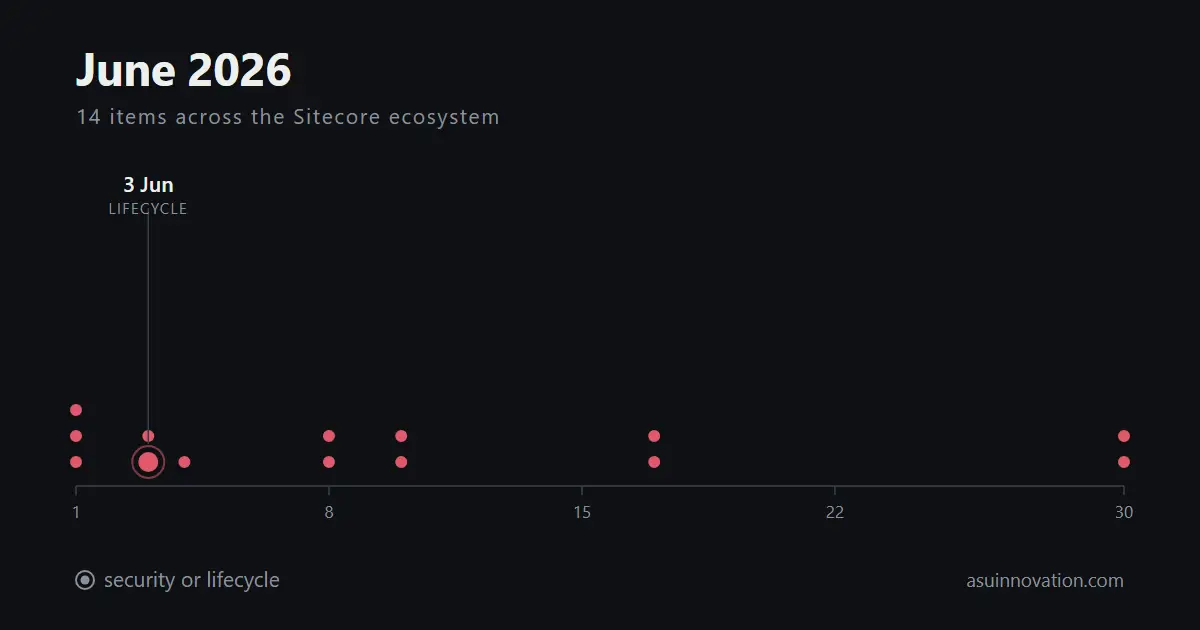
Two things happened to Sitecore in June 2026, and only one of them got the attention. Sitecore acquired Scrunch, an AI search optimisation company, on 3 June. The other thing was a single chart post explaining that Sitecore JSS is winding down and Content SDK is where the platform is going.
If you run a headless Sitecore front end, read the second one first. It is the only item this month with a date you can put in a plan.
The date that belongs in your planning: JSS 22 and Content SDK
The post is on exdst.com. Our source record lists the outlet as Anton Tishchenko and the page itself carries no byline, so we cannot credit an individual for it. It plots which SDK versions SitecoreAI supports over time, and it says JSS 22 maintenance reaches end of life in June 2026, with no support planned for any newer JSS version. Its conclusion is one line: "Content SDK is the path forward."
Two caveats before you act on that. First, this is a community source citing a Sitecore support KB article rather than the KB itself, and support dates are exactly the class of claim you should confirm against Sitecore's own knowledge base before you size a migration. Second, the post closes by offering to map your upgrade path, so the author's firm sells the work the post recommends. Our record leaves its commercial interest unresolved, which is not the same as neutral.
What makes it worth reading anyway is the mechanism. Content SDK was copied out of JSS in December 2024 with no shared git history, then the two diverged. That is why the migration is mostly mechanical and also why "mostly mechanical" across a multisite front end still costs a quarter of somebody's year.
Scrunch, and the claim that your website is now source material
Sitecore's own writing on the acquisition carries bylines, which our harvest recorded as uncredited. The record was wrong on all three Sitecore Insights items and we are naming the authors here.
Michelle Boockoff-Bajdek, Sitecore's CMO, made the strategic case on Sitecore's own blog: the website has stopped being only a destination and "is now the source material for your brand." That is a vendor explaining its own acquisition, so it is positioning rather than analysis, but the underlying observation is the one every content team will be arguing about in 2027.
Jhanavi Vijay Kumar's post on Agentic Studio, also on Sitecore's blog, is the product launch: agents embedded in Page Builder that already have the page's context. And Jonathan Corley's piece on the AI-influenced traveler applies the same argument to one vertical. Both are Sitecore writing about Sitecore. Read them for direction of travel, not for evidence.
The engineering read of the month is Vishal Khera's Scrunch playbook on his own blog, Insights with Vishal Khera. His framing is the useful one: AI agents crawl differently from search engines, rarely execute JavaScript, and consume tokens, so the patterns that matter are edge-level agent detection and getting critical facts into server-rendered HTML instead of client hydration. That is a concrete architectural instruction you can act on without buying anything. Khera also reports a Bloomberg figure of roughly $225 million for the deal; that is his citation, not a vendor-confirmed number, so check it before you repeat it.
Three AI search rollout guides, all from the same implementation partner
Alexei Vershalovich published three pieces at Brimit in June. Brimit implement Sitecore commercially, which is worth holding in mind through all three.
The measurement guide is the one with practical value: define your metrics before the pilot launches, and structure them per team rather than as one blended number. The rollout guide draws a line between keyword search with machine-learning features, where it puts Sitecore Search, and semantic search over vector embeddings. That distinction stops a lot of pointless procurement arguments. The platform comparison covers thirteen vendors and is honest that capabilities were evaluated as of May 2026. Treat it as a partner's market map.
The engineering that was not about AI
Devanshi's post on Content Hub DAM and SitecoreAI, on her blog Tech Insights By Devanshi, found the operational hole nobody advertises. When the DAM connector puts a public Content Hub URL in a standard image field, the link between asset and page exists only as a string inside field values. Neither product gives you "where used", so answering "can I delete this image" means scanning Layout Service responses across every page of every site. Decide how you track that at publish time, or you will be writing the crawler later.
Ronald van der Plas, writing at Content Insights, asks the question composable architecture diagrams keep skipping: where does the connective tissue run. Webhook receivers, cache revalidation, index workers and sync jobs have to live somewhere, and if you never name that runtime it ends up inside the frontend repo. He argues Azure Container Apps fits that gap without full Kubernetes.
A phased WordPress to Sitecore migration with both CMSs serving one site is documented on Koushik Mukherjee's blog; our record shows no byline on the post itself. The routing is done with Netlify Edge Functions so URLs and rankings survive a migration that runs for months. And a post published under the site handle 360Agileweb, with no personal byline, works through running Next.js on Azure App Services with multisite, against Sitecore's serverless recommendation. Useful when governance has already decided you are on Azure.
Underneath: your IDE now checks the MCP servers
Mark Downie's June Visual Studio update, on Microsoft's own Visual Studio Blog, added trust validation for MCP servers: the configuration is compared against a trusted baseline before the server starts, and its tools are fingerprinted after. If your team has wired MCP servers into Sitecore work, that check is the difference between a server that changed under you and one you approved.
What we would argue
Timothy Marsh's "The Empire Strikes Back", on his own site, is the best-written thing in this list. His subject is Salesforce buying Contentful and what he calls the composable monolith: "It looks composable from the outside. It behaves like an ecosystem from the inside." We had no primary source for the deal terms in this month's harvest, so treat his account as his, and confirm before you quote it in a board paper. His read on Sitecore is complimentary, and our record does not resolve his commercial interest either way.
Six of the fourteen items here come from Sitecore or from a consultancy that implements Sitecore. That is what a month narrated by its vendor looks like, and it is worth naming rather than averaging away.
The opinion: this ecosystem spent June writing about being cited by machines and produced exactly one post with a support date in it. If your 2027 plan has a line for AI search readiness and no line for the SDK your front end is actually built on, you took your priorities from the marketing calendar instead of the support calendar. Fix that order.
Sources
- SitecoreAI, Content SDK, and JSS Support Timeline — no byline on the page; outlet recorded as Anton Tishchenko
- Two CMSs, One Website: Managing Routing During WordPress to Sitecore Migration — no byline in our record; Koushik Mukherjee's blog
- SITECORE + SCRUNCH: A Developer's Playbook for AI Search on SitecoreAI — Vishal Khera, Insights with Vishal Khera
- From Pilot to Performance: Measuring and Executing Your AI Search Rollout — Alexei Vershalovich, Brimit
- Azure Container Apps: the missing runtime layer in composable architecture — Ronald van der Plas, Content Insights
- SitecoreAI – Unlock massive enterprise scale with Next.js Web Apps on Azure and Multisite Architecture — published under the site handle 360Agileweb
- AI agents that work the way your marketing team does — Jhanavi Vijay Kumar, Sitecore Insights
- The AI Search and Recommendation Rollout Guide for DXP and E-Commerce — Alexei Vershalovich, Brimit
- How AI Is Reshaping the Content Stack: A CMO's Guide to DXP, CMP, and Content Infrastructure Platforms — Alexei Vershalovich, Brimit
- The Empire Strikes Back — Timothy Marsh
- AI is the new marketing channel. Are you ready? — Michelle Boockoff-Bajdek, Sitecore Insights
- The AI-influenced traveler: How AI is changing travel discovery — Jonathan Corley, Sitecore Insights
- Visual Studio June Update – Track Your Usage, Trust Your Tools — Mark Downie, Visual Studio Blog
- Content Hub DAM + SitecoreAI: The Hidden Operational Challenge — Devanshi, Tech Insights By Devanshi