
May 2026: Sitecore renamed the platform and the community wrote the manual
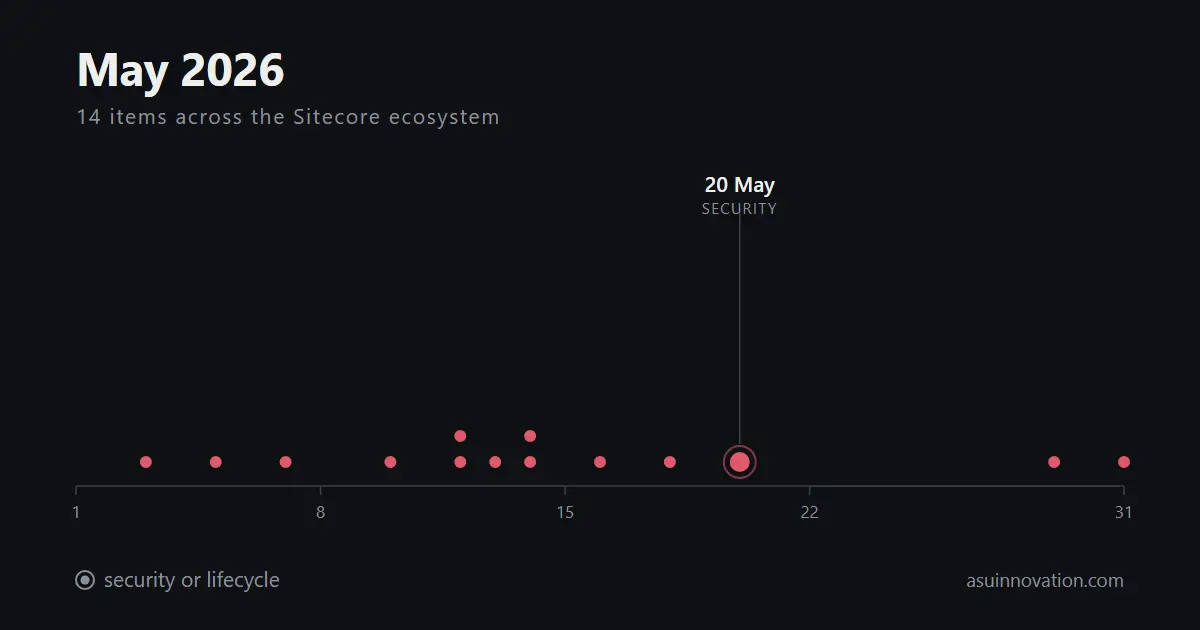
If you run a headless Sitecore front end, the item from May that changes your week is a bug-fix
release note. Content SDK 1.6.0 closed a hole where preview let people reach pages they had no
permission to see, and shipped a PreviewMiddleware to gate preview requests.
Everything else in May was one story, told over and over: SitecoreAI. Almost none of the telling came from Sitecore.
The only release note that changes what you ship
Sitecore/content-sdk 1.6.0 — yavorsk, Sitecore Content SDK releases
Four fixes worth reading before your next deploy. Preview allowed access to pages without proper
permissions, and preview mode showed unpublishable content. The React Form component lost
interactivity and state between rerenders. searchParams came back empty on statically generated
pages with Draft Mode on Vercel, which the release notes attribute to a known Next.js behaviour
rather than an SDK bug, and which now has a client.getPreviewInputs helper as the supported path.
If your team wrote its own preview route rather than using the SDK's, you are the one enforcing
permissions on it, and nothing in this release does that for you.
A JSS end-of-support date with one source, and that source is not Sitecore
Technical Guide: Migrating from Sitecore JSS 22.0 to Content SDK 2.1 — Gabriel Baldeon, Sitecore Center Baldeon opens with a lifecycle claim: technical support for Sitecore JSS ends in June 2026, so XM Cloud teams have to move to Content SDK 2.1. That is a date with budget attached, and in what we harvested this month it has exactly one source, which is this post. His reference list names Sitecore's lifecycle guidelines without linking them. Treat the date as Baldeon's reading and get it confirmed on Sitecore's own lifecycle page before you resource the work.
The rest of the guide is the most practical thing published about Sitecore in May. He calls the
move "an architectural re-engineering that optimizes content delivery", and the specifics back
that up: Node 24 or later, Next.js 16.2, middleware.ts becomes proxy.ts with a chain that has
to execute in the order locale, multisite, redirects, personalize, environment variables renamed
or dropped, and the old pageEditing and pageState booleans replaced by a single PageMode
object. The bundle-size numbers he quotes come from his own comparison diagram, so treat them as
his measurement rather than a vendor benchmark.
What SitecoreAI Pathway actually migrates, and what it leaves behind
SitecoreAI Pathway: Migrations simplified — Praveen Singh Panwar
The most useful sentence in the month is a limitation. Panwar describes two Pathway routes: XM/XP
to SitecoreAI, which migrates content only and does not carry xDB or marketing components across,
and a technology-agnostic route for non-Sitecore sites that works by crawling and scanning the
live site, so it needs a reachable sitemap.xml. He notes the tool is strict about the source
following Helix and using the default layout structure, and that it ships under the Sitecore360
subscription. If the value your client gets from XP lives in xDB and marketing automation, Pathway
is not the thing that moves it.
The rename, explained by someone who does not work at Sitecore
From XM Cloud to SitecoreAI and How Spaces and Agents Change Content Operations in SitecoreAI — Ramiro Batallas Two posts, and between them the clearest map of what moved where. Portfolio and Sites became Channels, Design Library and Components and Forms became Design, Planning and Projects became Strategy, Analytics became Performance, and Agentic is new. Print that table and put it next to whoever trains your editors, because the first support ticket after the rename will be somebody who cannot find the Media Library. The second post covers Spaces and Agents, the concepts the whole pitch rests on. Batallas writes on a personal blog that carries a Sitecore MVP 2026 badge; our source record does not resolve whether he has a commercial relationship with the product, so read him as a practitioner rather than as an independent auditor.
Sitecore's own two posts were about readiness, not product
Both pieces were harvested with no byline, and both are wrong in our record: the pages do credit authors, in the body rather than in the metadata.
The hidden reason AI struggles in marketing — Rona Williamson, Sitecore Insights The argument is that AI in marketing underperforms because the data underneath it is fragmented and nobody can say which system holds the truth. That is correct, and it is also the argument a company selling a unified platform would make. Useful for the conversation with a CMO who expects an AI feature to fix a governance problem. Not a substitute for evidence.
Five steps that set your SitecoreAI migration up to deliver — Alison Sainsbury, Sitecore Insights Sainsbury ran five workshops in Sydney with Colliers International before their XP to SitecoreAI migration, and this is her account of her own engagement, published by the vendor. The numbers are the interesting part: a survey of roughly 30 of their digital and marketing leaders put SEO and LLM visibility top of the 18-month list at 76%, and named customer experience the biggest friction point at 64%. Vendor-published customer stories rarely carry a denominator at all.
Governance is the part nobody has shipped
Brand Voice Isn't Broken by AI. Part 2 – Here's How to Keep It That Way — Timothy Marsh Marsh works through what EU AI Act Article 52 transparency obligations mean for AI-generated marketing content, then sketches how Content Hub's entity model could carry documented rulesets, audit trails and enforced review gates. He states plainly that this is a concept and not an existing feature, and we are repeating that here so nobody goes looking for it in the backoffice. The gap he is pointing at is real: a brand voice document and an approval workflow is a quality process, not a governance framework.
Migration numbers that should not go straight into a proposal
Content Migration Doesn't Have to Take Months: How AI Is Transforming Digital Replatforming — Alexei Vershalovich, Brimit Fifteen months down to five with Sitecore AI Pathway, roughly 70% of content model rebuilds automated, nine months down to three weeks with Uniform Siphon. Brimit implement this work commercially, so read the framing accordingly, and note what the post itself says: the outcomes are drawn from vendor documentation and published case studies, not from Brimit's own measurements. That makes them a hypothesis to test on your content, not an estimate to sign.
The Modern DXP and E-Commerce Handbook — Alexander Vergeichik, Brimit A series index from the same agency. Two sections have content, four are marked coming soon. Bookmark it if the composable and commerce material is your beat; there is not much to read yet.
Underneath the platform
dotnet/efcore .NET 11 Preview 4 — rbhanda
Sitecore XP and XM sit on this. The tag is mostly automated dependency bumps, but there are fixes
in it that on-prem teams will recognise: duplicate DbParameter naming, the GO batch separator
not being recognised inside comments and escaped identifiers, and path separators breaking
dotnet-ef tools on Linux and macOS. It is a preview, so this is planning input rather than
something to ship against.
What we would do about it
May's two facts with the largest blast radius were a permission gate in a GitHub release note and a support-end date on one person's blog. Neither arrived through a channel a client would ever watch. Meanwhile the vendor published an essay about data readiness and a customer story, and the work of explaining what the rename means operationally was done by community members writing on their own time.
That is a support cost transferred to you, and it is worth pricing. If your 2026 plan has a JSS migration in it, do not let the June date reach a statement of work until somebody at Sitecore has put it in writing. If it has a Pathway migration in it, write the xDB limitation into the scope document now rather than discovering it in week six. And if you are still deciding whether the rename is cosmetic, the navigation table in Batallas's post is the fastest way to find out that it is not.
Sources
- Sitecore/content-sdk 1.6.0 — yavorsk, Sitecore Content SDK releases
- Technical Guide: Migrating from Sitecore JSS 22.0 to Content SDK 2.1 — Gabriel Baldeon, Sitecore Center
- SitecoreAI Pathway: Migrations simplified — Praveen Singh Panwar
- From XM Cloud to SitecoreAI — Ramiro Batallas
- How Spaces and Agents Change Content Operations in Sitecore AI — Ramiro Batallas
- The hidden reason AI struggles in marketing — Rona Williamson, Sitecore Insights
- Five steps that set your SitecoreAI migration up to deliver — Alison Sainsbury, Sitecore Insights
- Brand Voice Isn't Broken by AI. Part 2 – Here's How to Keep It That Way — Timothy Marsh
- Content Migration Doesn't Have to Take Months: How AI Is Transforming Digital Replatforming — Alexei Vershalovich, Brimit
- The Modern DXP and E-Commerce Handbook — Alexander Vergeichik, Brimit
- dotnet/efcore .NET 11 Preview 4 — rbhanda