
November 2025: Sitecore renamed the whole product line, and not one of our sources was Sitecore
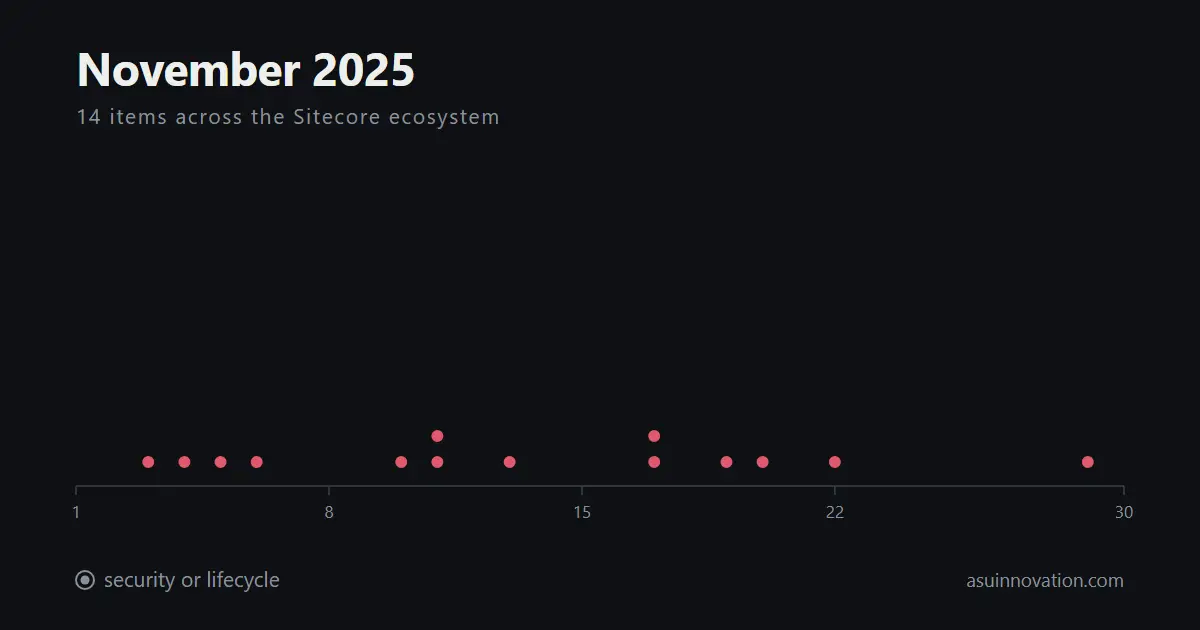
At Symposium in Orlando, Sitecore folded XM Cloud, CDP, Personalize, Search and Content Hub into a single product called SitecoreAI, and changed how all of it is licensed. Our harvest for November pulled 106 Sitecore items from 60 blogs. Not one of them was published by Sitecore.
That is the thing to carry into any November conversation. The packaging, the migration path and the price are the parts of this announcement that touch a contract, and every account of them we could reach was written by someone who sells services on the platform, attended the keynote, or both.
One caveat before the number does any arguing. November 2025 is a backfilled month, reached through feed archives rather than harvested as it happened. 106 is the largest Sitecore count in our corpus, and it measures what survived in feeds, not how busy the month was against any other month. Treat it as a fact about archives.
One keynote, refracted sixty ways
34 of the 106 items were published between 3 and 10 November, in the days around and after the keynote. 56 carried an AI signal. Exactly one carried a security signal, in a month where 28 items still concerned Sitecore XP. 33 of the 60 blogs published a single Sitecore item all month.
So the volume is not breadth. It is one event, retold.
The clearest short account of the shape came from Balaji Kandasamy on Bala Blog, who was in the room as an MVP: SitecoreAI sits on the XM Cloud foundation, and Sitecore Studio is the extensibility layer over it, made of Agentic Studio, App Studio, Marketplace and Sitecore Connect. He reports COO Dave Tilbury promising to keep licensing "simple with just one number", and that existing XM Cloud customers move to the new platform with no migration. Praveen Singh Panwar, writing on his blog Digital Experience, DXPs and Sitecore, adds Sitecore Pathway, the AI-assisted migration tool, and reports pilot data suggesting migration times cut by up to two thirds. That figure came off a stage, not out of a document, and it is Panwar relaying it in good faith. Do not put it in a business case without asking Sitecore for the underlying study.
Panwar's second piece, ten days later, is the more interesting one, because he asks the question the launch coverage avoided: is a unified platform not simply Sitecore XP again, on someone else's cloud? He answers it in Sitecore's favour, calling the unified SaaS platform "a masterstroke", and he is explicit that Platform DXP has its own roadmap for the next year. The question is still worth asking on your own account.
Ben Sewards at Tech Appetite wrote the most useful attendee report, because he wrote down the operational details nobody else did: that XM Cloud customers who have not signed the AI addendum receive SitecoreAI without AI features enabled until they sign, and that in a performance session the product team put a region-to-region VPN hop at over 13 seconds of added GraphQL ingress latency.
The two earliest structural write-ups came from Ronald van der Plas at Content Insights on 3 and 4 November. Both close with a disclaimer that the text "was generated with the assistance of AI to provide timely insights during the fast-paced announcements". They are accurate on the four Studio components and they are honest about how they were made, which is more than most launch coverage manages. The explainer from nikitavashisht29 on TECHHUB covers the same ground for a marketing audience and, like most of the month, restates Sitecore's own announcement. The record credits that handle and no other name.
The price, from a partner, with the partner saying so
The one piece that treats packaging as a procurement problem is Dan Cruickshank's pricing deep dive at Fishtank Consulting. Fishtank is a Sitecore Platinum Partner that sells SitecoreAI implementation, and the article sells its migration accelerator in the same breath, so read the enthusiasm accordingly. Read the structure anyway, because it is the only structure available: CMS, Unified Data Layer and Agentic Studio in the base; Search and Personalize merged into a Conversion Optimization module priced on a new metric called Experience Interactions; Content Hub arriving as a DAM module with a user-based count; core pricing on visits. Cruickshank is straight about the limit of his own post, writing that "Sitecore controls the pricing—not Fishtank" and that for real numbers "you'll need to talk to Sitecore directly". Every figure in that article is a partner's reading of a vendor's model. Confirm it with Sitecore before it reaches a budget line.
The parts that are actually engineering
Nick Allen
wrote the month's only serious developer content, at Think Fresh Digital, recorded in our harvest
as a specialist Sitecore delivery partner and closing both posts with an offer to run your
migration. Content SDK 1.2 shipped alongside Symposium with beta Next.js App Router support,
sitemap and robots generation, i18n, a client and server component split, and raw GraphQL through
SitecoreClient.getData(), which removes the manual client extension teams had been writing
since 1.0. His warning is the load-bearing sentence: App Router projects on 1.2 should not go to
production yet. That one is checkable against Sitecore's own changelog, and it is the only claim
here I would act on this week. His launch piece
carries the keynote line from CEO Eric Stine, "You can't publish content for the next generation
using yesterday's playbook", which is the clearest statement of what Sitecore thinks it is
selling.
Boris Brodsky published the only architecture detail anyone put in writing: AKS, Cosmos DB and Event Hub, one Cosmos DB account per tenant, 1,000 events per second per tenant, roughly 100ms ingestion latency at the 95th percentile, and Microsoft Fabric medallion support. Those numbers came out of the MVP Summit, and Brodsky is explicit that he is publishing what was shareable. They are a community report of a roadmap, not a service level, and they should not be sized against until Sitecore publishes them.
The only hands-on XM Cloud engineering in the cited set arrived sideways, through
Shrikant Sahu's index of his 2025 posts on SitecoreForU:
extending the Edge GraphQL schema so search queries can filter on _latestversion, because the
preview endpoint returns every item version and authors verifying results in Page Builder get all
of them. Our harvest recorded that link at the blog root rather than at a post, and recorded the
outlet simply as "Sitecore", which is the kind of feed metadata that makes checking a source
against the vendor harder than it should be.
What it does to the people who run the content
Petar Mitev, who publishes at Mitev Consulting on DAM and content operations and closes the piece offering a consultation, wrote the most useful argument of the month. SitecoreAI puts embedded DAM in front of organisations that never bought Content Hub, and it runs on their taxonomies, their metadata and their approval workflows. His line is the one to quote at a steering committee: AI "doesn't fix those problems. It amplifies them." Nothing in the November announcements changes a broken naming convention.
The counterweight came from Alex Van Unnik at Brimit, a Sitecore services firm writing to sell an analytics engagement, arguing that most teams should start with batch or near-real-time and buy real-time only where delay costs money. In a month sold on real-time everything, an implementer telling you to buy less of it is worth ten minutes.
Why 14 out of 106
With 91 items left on the floor, the filter matters more than usual. An item was cited if it did one of four things: reported a detail from inside the room that was not in the announcement, priced or scoped the change, described mechanics a developer can act on, or argued with the launch rather than restating it. Coverage that reproduced the announcement in different words did not qualify, however competent, because a reader gets that from Sitecore's own newsroom faster.
In aggregate, the 91 we dropped were mostly more of the same event. 31 of them carry the launch vocabulary in their titles. Most of the rest came from blogs that published once in November and covered ground already covered here. We are not claiming they are bad posts. We are claiming that in a month with one story, the fifteenth telling adds nothing a practitioner can use.
What we're watching
November 2025 was a contract event, not a product event. What changed in the first week of the month is your paperwork, your product boundaries and your renewal conversation. The only thing that changed in a repository is Content SDK 1.2, and its most important feature is explicitly not production-ready.
Here is the part worth disagreeing with: a platform that reorganises five products into one contract, and publishes nothing to the ecosystem's blogs while sixty of them explain it on the vendor's behalf, has outsourced its documentation to the people who profit from adoption. That worked in November because the partners writing were careful, and several of them flagged the limits of what they knew. It is not a reliable arrangement. One security-signalled item in a 106-item month, against 56 about AI, is the same imbalance seen from the other side.
Sources
- Sitecore unveils SitecoreAI: Open, agentic orchestration arrives for the CMS era — Nick Allen, Think Fresh Digital
- Deeper into the Content SDK for SitecoreAI — Nick Allen, Think Fresh Digital
- Reflecting on Sitecore Symposium 2025 — Praveen Singh Panwar, Digital Experience, DXPs and Sitecore
- Significance of Sitecore Symposium 2025 — Praveen Singh Panwar, Digital Experience, DXPs and Sitecore
- Sitecore Symposium 2025 Highlights — Balaji Kandasamy, Bala Blog
- Sitecore Symposium | Sitecore AI: The future of marketing, built for humans — Ronald van der Plas, Content Insights
- Sitecore Symposium | SitecoreAI: Customized SaaS Powered by Sitecore Studio — Ronald van der Plas, Content Insights
- My Sitecore Symposium 2025 Recap #SitecoreSYM — Ben Sewards, Tech Appetite
- Transforming Digital Experiences with SitecoreAI — nikitavashisht29, TECHHUB
- Deep Dive: SitecoreAI Pricing and Packaging — Dan Cruickshank, Fishtank Consulting (implements SitecoreAI commercially)
- From Sitecore CDP to Unified Data: What Sitecore's New Direction Means for 2026 — Boris Brodsky
- SitecoreForU All Blog Links 2025 — Shrikant Sahu, SitecoreForU (harvested link resolves to the blog root)
- SitecoreAI and what it really means for Content Hub, DAM, and Content Operations — Petar Mitev, Mitev Consulting
- Do You Really Need Real-Time Analytics? A Playbook for Manufacturing Leaders — Alex Van Unnik, Brimit (sells Sitecore services)