
October 2025: the Sitecore CLI can ship an empty package and still exit 0
If you build Sitecore item or resource packages in a pipeline, put dotnet sitecore ser validate in
front of the packaging step today. Corey Smith spent October documenting why: a malformed YAML file
makes the CLI print errors, write a 0 KB resource package, and then return exit code 0. The build
goes green and the empty package deploys.
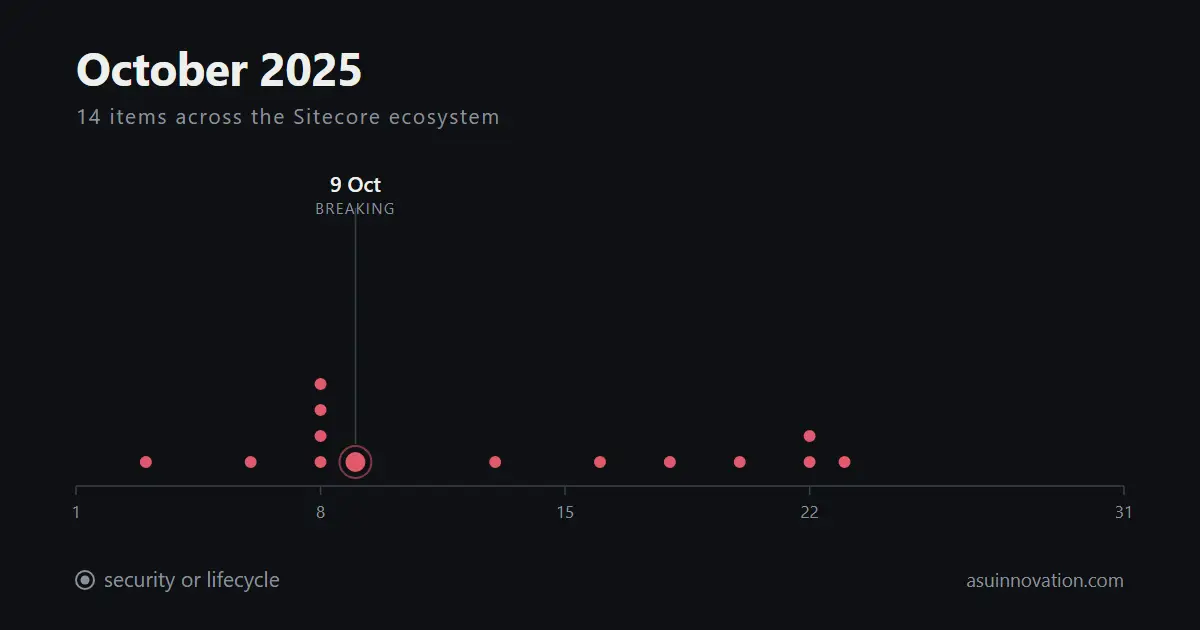
That was the most actionable thing to come out of Sitecore in October 2025, and Sitecore did not produce it. Every Sitecore item our harvest reached for the month came from a community or partner blog: 84 articles harvested across both CMSs, 70 in scope, 14 cited below, none from Sitecore's own channels. We rebuilt this month from feed archives and vendor changelogs are the first thing an archive loses, so read that absence as a hole in our record, not as silence from the vendor. None of the personal blogs below states an employer, so none should be read as independent; where we know a commercial position, it is named inline.
The packaging bug to fix before your next release
Sitecore CLI - Catch Package Generation YAML Errors — Corey Smith
His description of the failure is exact: "Error messages are output, but the itemres command
generates a resource package anyway; an empty, 0 KB resource package." Deploy that, he writes, and
if root items are missing from the IAR file, parts of the content tree can go with them. He says he
reported it to Sitecore, and offers two defences: run ser validate before packaging, and wrap the
packaging step in a PowerShell script that watches for the known error strings and fails any package
under a size floor. He pins the behaviour to CLI 6.0.23 and believes earlier versions carry it too.
That version number is his, not Sitecore's, so check your own CLI before you write the ticket.
Two SDKs, and only one of them has a future on XM Cloud
JSS SDK vs Content SDK: A Practical Decision Flow for Developers — Kiran Patil, Sitecore basics! The choice reduced to three branches: new build on XM Cloud, take the Content SDK; new build that is not XM Cloud, JSS still covers more ground; existing JSS app, cost the migration out and schedule it anyway.
Migrating Your Sitecore JSS App to Content SDK: A Complete Guide — no author in our source record; published on the blog Koushik Mukherjee - Sitecore MVP
The migration at the level of file names: get to JSS 22.8 first, SitecoreClient replaces the old
REST and GraphQL services, defineMiddleware replaces the middleware plugins, component-map
replaces componentBuilder, and the environment variables are renamed. The line that moves
schedules is that Experience Editor is gone; Content SDK is Pages only. Both that and the version
floor come from a community post, so confirm them in Sitecore's own migration documentation before
you promise anyone a date.
Step-by-Step: Creating Sitecore Content SDK Components in Next.js Manually and with AI — Kiran Patil, Sitecore basics! The same component built twice, once by hand through a cloned rendering and the scaffold command, once by prompting Cursor. A before-and-after of what the model actually saves you, which is the boilerplate and not the template design.
The Real Story Behind XM Cloud Components: A Marketer's Dream or Developer's Dilemma? — Kiran Patil, Sitecore basics! The counterweight to the low-code pitch, and the most honest list of limits anyone published this month: no design-system sync from Figma, no promotion pipeline between environments, manual breakpoints, and a JSON runtime he argues costs you Core Web Vitals under traffic. His verdict is that they "have constraints that make them a poor fit for large-scale enterprise experiences", which is roughly what teams discover around month four.
The agentic surface arrived through other people's blogs
Sitecore MCP Basics — Kiran Patil, Sitecore basics! The orientation piece, and the one that makes the month's structural point without meaning to: the Sitecore MCP server most people are using is a community project, not a Sitecore product.
From Figma Design to Sitecore Rendering in a Few Minutes — the page carries no byline; published on Anton Tishchenko's site Figma MCP, Chrome DevTools MCP and the Sitecore MCP server in one agent loop: read the selected frame, create the datasource template and rendering, write the Astro rendering, put it on a test page, then look at the result in the browser and fix it. He wrote the Sitecore MCP server this runs on, so this is a demonstration of his own tool, and his site names no employer we could confirm. He prices the toolchain at 15 dollars a month for the Figma seat and 20 for Cursor Pro, both third-party products and both October figures, so check before you budget.
Sitecore's Agentic Tasting Menu — Roel van Roozendaal, Restaurant of Mistaken Orders A tour of the Agent API, Marketer MCP, AXP and Agentic Studio, written as a tasting menu, which is funnier than it sounds and clearer than the alternative, which was nothing. He also writes the best line of the month: "Most AI in content ops is a polite intern: it drafts, it suggests, it nods." Everything here about the roadmap is second-hand for us, with no vendor-official source in this window, so confirm the scope with Sitecore before you plan around it.
Automate Section Enrichment in Sitecore Stream Using Enrichment Pipeline API — Chirag Goel, Coders Lifeline
The only post this month that treats Sitecore Stream as an API rather than a promise: client
credentials for a token, then a POST to the EnrichSectionsPipeline endpoint to have brand-kit
sections tagged and classified, with C# to drive it. He dates the endpoint to July 2025, which is
his claim and not Sitecore's.
Personalization got a nine-part manual and nobody signed it
Three parts of a nine-part Sitecore Personalize series landed on the same day in October, published under the handle scorewow, which is the only name the blog gives.
Advanced Targeting with Multiple Conditions, Implementation in Practice: From XM Cloud to Web Experiments and Implementation Roadmap: My journey to Personalization Excellence — scorewow, Score Wow! Between them: AND/OR grouping with the evaluation order spelled out, the Pages editor walkthrough alongside the Layout Service payload that personalization actually returns, and a phased rollout that starts with edge-friendly conditions such as country, device and UTM before anything behavioural. Two constraints in there will shape a design if they hold: a stated ceiling of five conditions per experience, and evaluation stopping at the first match. Both come from an unsigned blog, so verify them in your own tenant first.
AI as the migration tool, and one post that is a brochure
Word Docs to Websites: How I Used AI to Migrate AEM Franklin Content Into Sitecore — signed Patt, Patt's Sitecore Blog
The most reusable method of the month. AEM Franklin authors in Word documents, so the export is
.docx and not JSON. Patt had a model turn the documents into a JSON array against a fixed page
schema, fell back to the live page's og:image when an image would not extract from the file, then
imported with a short PowerShell script. The gotchas are the good part: most documents had a
"People Cards" table and the rest called it "People Cards (Phone)".
(Use Case Library) How Leading Manufacturers Use Data and AI to Innovate and Cut Costs — Alex Van Unnik, Brimit Twenty-odd manufacturing AI case studies with numbers attached, published by Brimit, who sell Sitecore implementation services commercially. There is no Sitecore in it. It is listed because it was in the month's Sitecore harvest and you should be able to see what that harvest contains, not because it tells you anything about the platform.
What October was
Sitecore in October 2025 is a platform whose working knowledge sits on about a dozen personal WordPress and Blogspot sites. Half of what we cite comes from two of them: four items from Kiran Patil's blog, three from Score Wow. That is not a complaint about either author, who between them published more usable material this month than we could reach from the vendor. It is a measurement of how thin the layer is.
The argument worth having is about the Agent API. When the clearest available explanation of a new product surface is a restaurant metaphor on someone else's blog, and the person demonstrating the most convincing agent workflow is the person who wrote the unofficial server it runs on, the community is not filling a gap in the documentation. It has become the documentation. That holds until one of those people changes job.
If you do one thing from this post: ser validate, in the pipeline, before packaging.
Sources
- Sitecore CLI - Catch Package Generation YAML Errors — Corey Smith
- JSS SDK vs Content SDK: A Practical Decision Flow for Developers — Kiran Patil, Sitecore basics!
- Migrating Your Sitecore JSS App to Content SDK: A Complete Guide — no author recorded, Koushik Mukherjee - Sitecore MVP
- Step-by-Step: Creating Sitecore Content SDK Components in Next.js Manually and with AI — Kiran Patil, Sitecore basics!
- The Real Story Behind XM Cloud Components: A Marketer's Dream or Developer's Dilemma? — Kiran Patil, Sitecore basics!
- Sitecore MCP Basics — Kiran Patil, Sitecore basics!
- From Figma Design to Sitecore Rendering in a Few Minutes — no byline on the page, published on Anton Tishchenko's site
- Sitecore's Agentic Tasting Menu — Roel van Roozendaal, Restaurant of Mistaken Orders
- Automate Section Enrichment in Sitecore Stream Using Enrichment Pipeline API — Chirag Goel, Coders Lifeline
- Advanced Targeting with Multiple Conditions: Building Sophisticated Audience Logic — scorewow, Score Wow!
- Implementation in Practice: From XM Cloud to Web Experiments — scorewow, Score Wow!
- Implementation Roadmap: My journey to Personalization Excellence — scorewow, Score Wow!
- Word Docs to Websites: How I Used AI to Migrate AEM Franklin Content Into Sitecore — Patt, Patt's Sitecore Blog
- (Use Case Library) How Leading Manufacturers Use Data and AI to Innovate and Cut Costs — Alex Van Unnik, Brimit